
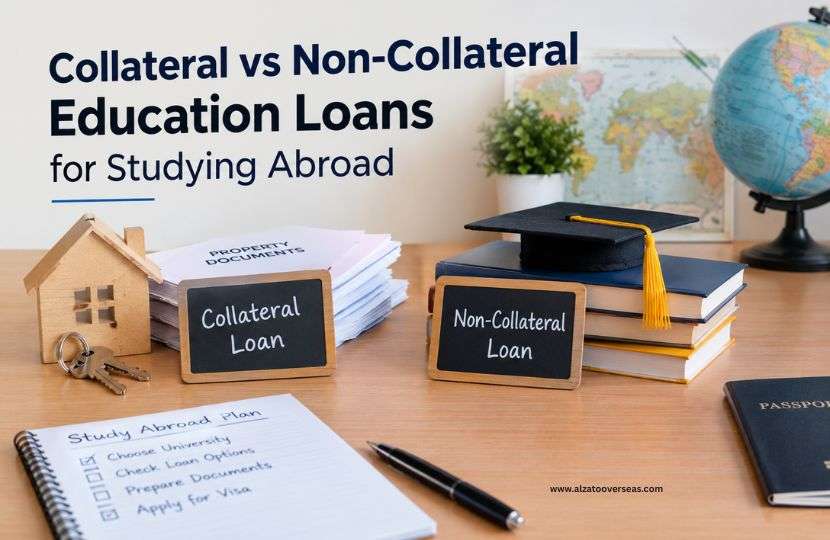
To go abroad for studies requires a lot of money from the students and their family members. Apart from paying tuition fees, students have to make arrangements for their accommodation costs, living expenses, travel expenses, and other related expenditures, which necessitates a big sum of money. With the help of an education loan, managing these expenses becomes easier, but students often get confused about the logistics of collateral and non-collateral education loans.
With the help of understanding these two options in detail, students can make well-informed decisions about their finances with reference to applying at foreign colleges.
What Is a Collateral Education Loan?
A collateral education loan occurs when an asset offered by the borrower is used for the loan’s security. Depending on the institution, it can be real estate, fixed deposits, government bonds, or any other eligible asset.
While reviewing the loan application, the lending company looks at the value of the collateral in combination with the student’s academic performance, admission documents of the university, and financial information regarding the co-borrower.
This type of loan can be an option for students needing a considerable amount of money, provided their families have an asset to pledge as collateral. However, families have to be fully aware of the loan terms and repayment responsibilities before offering an asset as collateral.
What Is a Non-Collateral Education Loan?
A non-collateral educational loan does not make it obligatory for the student and family to offer real estate or any other property as collateral. The lender may assess the student’s academic record, the institution and qualification chosen, the income, credit history and potential for repayment of the co-applicant.
This can be something that students may consider if they lack property for collateral. However, the limitations of the loans and eligibility criteria actually depend on the lender as well as the academic and financial background of the student.
Which Loan Is Suitable for Studying Abroad?
There is no single loan type that suits all students. Different factors should be considered when deciding what loan type to choose, such as amount required, family financial situation, eligibility of the co-applicant, the institution chosen and the price of the degree.
If the loan amount is big and you have collateral to offer, a secured loan is a good option to consider. If you don’t want to use property as collateral and you qualify for the terms of non-collateral loans, you can choose this type.
Students should compare the terms of different loans instead of only looking at the interest rate or loan limits.
What Documents Are Required?
Different lenders have different requirements. Students may often have to show the admission letter, fee structure, academic credentials, passport and KYC papers.
The co-borrower may have to produce income proof, bank statements and other work or business-related documents. The collateral loans may require proof of ownership and valuation of the property as well.
Can You Study Abroad Without Collateral?
There are some lenders who offer education loans without any tangible collateral but the approval is not guaranteed. The lender will check the reputation of the university, course, student academic credentials, co-borrower income, credit history and repayment ability.
Students must check the eligibility norms of the lender before applying for loans.
What Should You Check Before Taking an Education Loan?
Education loan is a long-term loan so students & parents must check details like interest rate, processing fees, margin requirement, moratorium period, repayment period and prepayment clauses.Also, determine your total study abroad costs before going in for the actual loan.
How Can a Study Abroad Consultant in Bhopal Help?
Making plans for the finances is an essential component of studying abroad. The study abroad consultancy firm in Bhopal can assist students in figuring out what documents they need and how to prepare the entire admission process into the university.
Students looking for a foreign education consultancy in Bhopal can also seek advice on how to prepare their study-abroad budget.
Nonetheless, the final loan approval from a bank or financial institution, interest rates, and repayment terms will be determined by the relevant institution.
Conclusion
Several factors, such as family finances, co-applicant profile, cost of education, and repayment capacity, will help you figure out whether you should take a collateral or a non-collateral loan. It is vital to understand the repayment term, processing fees, lending rates, and other factors before signing up for your loan. You can minimize the financial pressure involved in studying abroad by planning your finances in the right manner. If you are planning to study in a foreign country and wish to know how to go about sending your applications, admission process, getting student loans, etc., a consultant providing abroad education consultants in Bhopal can help.
For more information related to abroad education book a free overseas eudcation cousnelling today